


How to Choose the Right Liftgate?
Are you looking to choose a liftgate for a truck or trailer? According to Louis Chevrier, a liftgate specialist at CANVEC, the three most important criteria are the type of vehicle, the actual weight of the cargo, and the delivery environment. Most mistakes occur when a model is chosen before analyzing the actual needs of the operation.
In short :
- Always start by analyzing the vehicle.
- Allow for a safety margin in the lifting capacity.
- Choose the type of liftgate based on your operations (Tuckaway, Railgate, Slider, etc.).
- Never assume that there is a standard model suitable for all trucks.
When it comes time to purchase a liftgate (load lift, gate, or tailgate), many fleet managers think all they need to do is choose a lifting capacity and sign the purchase order…
In this article
- 3 Questions to Ask Yourself Before Buying
- Why There Is No Standard Liftgate
- Which Capacity to Choose
- The Best Liftgate for Urban Delivery
- Maxon vs. Waltco vs. Dhollandia
- Liftgate or Tailgate: What’s the Difference?
- The Most Costly Mistakes to Avoid
Let’s go!
How to Choose the Right Liftgate: Tips from a Field Expert
When it comes time to purchase a liftgate (load lift, gate, or tailgate), many fleet managers think all they need to do is choose a lifting capacity and sign the purchase order. In reality, it’s much more complex than that.
To demystify the subject, we spoke with Louis Chevrier, a liftgate specialist at CANVEC, who works daily with transportation, distribution, food service, and logistics companies to help them select the right equipment. His answers reveal a reality that is often overlooked: there is virtually no such thing as a “standard” liftgate.
The first mistake: starting by looking at the models
According to Louis, most buyers start their decision-making process in the wrong place.
« People often want a quick answer. They want to know which model to buy before they’ve even analyzed their needs. That’s probably the most common mistake I see. »
Before even discussing brands or models, Louis always asks three fundamental questions:
1. What kind of vehicle is it?
- Is it a straight truck?
- A trailer?
- A Transit?
- A Sprinter?
- A ProMaster?
- A truck that’s already equipped?
The type of vehicle directly affects the available installation options.
2. What is the actual load to be lifted?
It is important to understand :
- The maximum weight of the skids
- The type of goods being transported
- The dimensions of the loads
- The frequency of deliveries
3. What type of liftgate is suitable for this operation?
Some of the most popular options include :
- Tuckaway
- Railgate
- Slider
- Conventional platform
Each architectural style meets a specific need.
« Before we talk about price, I want to understand the customer’s equipment, workload, and operations. Only then will we start looking at the models. »
There isn’t really a standard liftgate
This is probably the point that surprises fleet managers the most.
Even when two companies have the same truck model, the recommended liftgate can be completely different.
Why?
Because the following factors must be taken into account :
- The vehicle’s total weight
- The chassis dimensions
- The floor height
- The location of electrical components
- Loading requirements
- Operating conditions
« Everyone thinks there’s a standard template. Yes, there are popular templates, but in reality, every project is customized. »
This is even more important in older vehicles.
A 15-year-old truck may require :
- Structural reinforcements
- Additional supports
- Electrical modifications
- Special modifications to the hydraulic system
That is why une a preliminary assessment of your liftgate needs remains essential.
Why Choosing a Capacity That’s Too Small Is a Bad Idea
A scenario Louis encounters regularly:
The customer is transporting 2,300-lb skids.
So he chooses a 2,500-lb liftgate.
On paper, everything seems perfect.
But in reality?
The driver often climbs onto the platform with the cargo.
The combined weight then exceeds the intended capacity.
Result :
- Premature wear
- Damaged components
- Risk of breakage
- Potential loss of warranty
« You should always build in a safety margin. Being too tight on costs often ends up being more expensive in the long run. »
«I have often seen customers break their liftgates because they exceeded the capacity. One customer regularly transported skids that exceeded the rated capacity of his liftgate. After several months, the structure began to warp, and the repair cost several thousand dollars. A preliminary analysis would have made it possible to choose the appropriate capacity from the start. »
How the Vehicle’s Weight Affects the Project
One aspect that is often overlooked is the vehicle’s total weight.
Adding a liftgate can add several hundred—or even more than a thousand—pounds to the weight.
This may affect:
- Available payload
- Cargo capacity
- Regulatory requirements
- In some cases, the required license class
« If you add a lot of weight to a vehicle that’s already close to its limit, it can completely change the project. »
That is one of the reasons why preliminary measurements and calculations are so important.
What’s the best liftgate for urban delivery?
If Louis had to choose just one type of liftgate for urban deliveries using a box truck, his choice would be clear : Le tuckaway
Why ?
Because it offers several advantages :
- Compact
- Versatile
- Easy to use
- Space-saving
- Protected under the truck
« In the city, the tuckaway is often the best choice. It’s located under the truck rather than on the outside, so it’s better protected and doesn’t add much length to the vehicle. »
This type of liftgate is particularly suitable for :
- For 16- to 20-foot box trucks
- For urban delivery vehicles
- For multi-stop operations
Which liftgate should you choose based on your industry?
Food Delivery
For food distributors, it all depends on the maximum weight being transported.
A company that transports:
- Pallets of soft drinks
- Pallets of beer
- Heavy goods
will not have the same needs as a potato chip distributor.
The Railgate and Slider models are often the preferred choice for this type of application.
Furniture Delivery
In furniture, the width of the platform becomes a critical factor.
A sofa or a large table may require:
- A wider platform
- Greater stability
- More room to maneuver
Heavy materials
Companies that transport:
- Concrete
- Steel
- Industrial Products
should generally prioritize the highest capacities.
Some configurations can have a lifting capacity of up to 6,600 lb.
Which are the three most popular brands: Maxon, Waltco, or Dhollandia?
One question comes up again and again: Which brand is the best ? Maxon, Waltco, Dhollandia or another one?
Selon Louis :
« Maxon, Waltco et Dhollandia sont toutes d’excellentes marques. Au niveau de l’utilisation quotidienne, elles sont très comparables. »
The difference often lies more in:
- Parts availability
- The selected model
- The specific application
- Customer preferences
Rather than looking for “the best brand,” it’s generally more important to find the right model for the right application.
Our Liftgate Comparison Guide is frequently shared with our customers to help them better understand the differences between the leading liftgate brands available on the Canadian market. In particular, you’ll find a comparison of the Maxon, Waltco, and Dhollandia brands, as well as practical advice on choosing the solution best suited to your operations.
Check out the complete guide :https://www.canvec.com/en/liftgate-brand-comparison-guide/
The Problem That Costs Carriers the Most
Without hesitation, Louis identifies the main cause: : overloads.
When a liftgate is used beyond its intended capacity :
- The cylinders are strained
- The structures become deformed
- The platforms may crack
- Repairs become extensive
« When you come across bent frames or torn platforms, you sometimes start to wonder whether it’s better to repair the liftgate or replace it entirely. »
Improper use can quickly turn a minor repair into an investment of several thousand dollars.
Beyond Compensation: The Hidden Cost of Injuries
When the topic of liftgates comes up, many managers first think of installation or repair costs. However, injuries related to material handling often pose an even greater financial risk. According to data from the IRSST, a musculoskeletal disorder associated with material handling results in an average of 88 days of work absence, while more than half of all recognized musculoskeletal disorders affect the back.
Furthermore,, according to the IRSST and the CNESST, musculoskeletal disorders (MSDs) account for more than 25% of compensated work-related injuries in Quebec. Of these injuries, more than half affect the back, and 56% are associated with material-handling activities.
This is one of the reasons why many companies are investing in mechanical material-handling equipment, such as liftgates, to reduce the repetitive physical strain on drivers and delivery personnel.
For Louis Chevrier, a well-designed liftgate does more than just help move goods more efficiently. It also helps reduce the repetitive physical strain on drivers and delivery personnel, which can have a positive impact on safety, productivity, and employee retention.
The advice Louis would give to all fleet managers
His answer is simple:
« Ask as many questions as possible. Forget the standard answers. The more you know about your needs, your work environment, and your vehicles, the better-informed your decision will be. »
For him, the success of a project begins long before installation.
It begins with a thorough analysis:
- The vehicle
- The operation
- The driver
- The type of cargo
- The work environment
A Myth to Debunk
What is the biggest myth, according to Louis?
« To think that there’s a one-size-fits-all liftgate that works for everyone. »
The reality is quite different.
Every vehicle, every operation, and every company has its own constraints.
So the right liftgate isn’t necessarily the most popular or the cheapest one.
It’s the one that precisely meets your operational needs.
Why You Should Consult a Specialist Before Buying
With thousands of dollars at stake, several possible configurations, and direct impacts on productivity, consulting a specialist can help prevent many mistakes.
« An expert will often raise questions that the client hadn’t even considered. This makes it possible to reach a much more informed decision right from the start.»
After more than 35 years of supporting Quebec-based carriers, CANVEC has found that a thorough pre-purchase analysis generally allows for:
- To avoid capacity errors
- To reduce repair costs
- To extend the service life of equipment
- To improve operator safety
- To optimize delivery operations
And as Louis points out, a well-advised customer is usually a satisfied customer long after the installation.
« The vast majority of customers who have us install their liftgates are very satisfied with the results because we take the time to assess their needs before recommending a solution. »
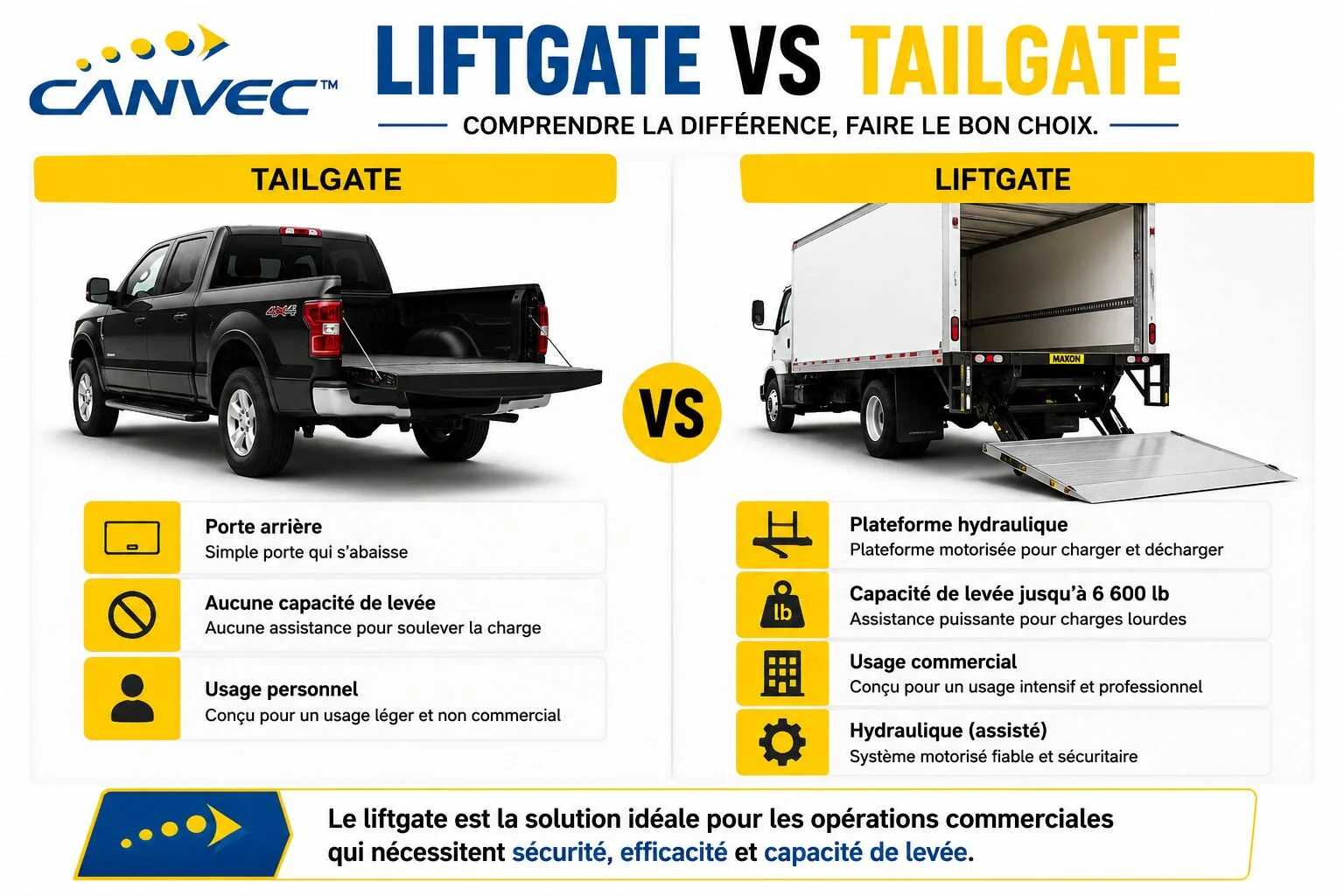
Liftgate or Tailgate: What’s the Difference?
At CANVEC, this is one of the most common questions we receive.
Many people use the terms liftgate, tailgate, tailboard and cargo lift as if they meant the same thing. However, there is an important difference.
What is a tailgate ?
The term tailgate simply refers to the rear panel of a vehicle.
For example: :
- The rear panel of a pickup truck
- The hatchback of an SUV
- The folding rear door of a light-duty truck
A tailgate is generally not designed to lift loads mechanically.
In short, a tailgate is a rear door or panel.
What is a liftgate ?
A liftgate is a hydraulic or electrohydraulic platform installed at the rear of a truck or trailer.
Its functions are to:
- Lift pallets
- Lower merchandise
- Facilitate loading and unloading
- Reduce the risk of employee injuries
Liftgates are commonly used in:
- Food delivery
- Furniture transport
- Commercial distribution
- Urban delivery operations
- Transportation of heavy materials
A liftgate is a material-handling device designed to lift loads, whereas a tailgate is simply a rear door.
Why does this confusion exist?
In the United States, many people use the word “tailgate” generically to refer to a liftgate.
In French-speaking Canada, the most commonly used terms are:
- Liftgate
- Loading lift
- Cargo lift
- Hydraulic loading platform
In the transportation industry, when referring to equipment capable of lifting pallets or cargo, the correct term is generally liftgate.
Quick Comparison Chart: Liftgate VS Tailgate
| Feature | Tailgate | Liftgate |
| Primary Function | Close the rear of the vehicle | Lifting and lowering goods |
| Hydraulic system | No | Yes |
| Lifting capacity | None | Up to 6,600 lb and more |
| Used for skids | No | Yes |
| Commercial Trucks | Rarely | Very frequent |
| Reduces handling-related injuries | No | Yes |
Louis’s Advice
« When a customer calls us about a tailgate, we always take a few minutes to confirm exactly what they’re looking for. In many cases, they’re actually referring to a liftgate. This clarification allows us to recommend the right solution from the start. »
Key Takeaways
- There is no such thing as a universal or standard liftgate.
- The type of vehicle is the primary factor influencing the choice of model.
- The capacity should always include a safety margin to account for actual conditions of use.
- Tuckaway models are often preferred for urban delivery.
- Railgates and Sliders are popular in food service applications and on trailers.
- The vehicle’s gross weight can affect regulatory compliance and available payload.
- Overloading is the leading cause of major breakdowns and costly repairs.
- The Maxon, Waltco, and Dhollandia brands all offer reliable solutions when properly matched to the application.
- An assessment by a specialist helps prevent mistakes that could cost several thousand dollars.
- A well-chosen liftgate improves safety, reduces handling times, and increases the productivity of delivery operations.
The Expert’s Advice
“Forget the standards. The better you understand your needs, your vehicle, and your work environment, the more informed your decision will be.” — Louis Chevrier, liftgate specialist at CANVEC
About the Liftgate Expert: Louis Chevrier
The tips presented in this article come from Louis Chevrier, an account manager specializing in liftgates at CANVEC.
Every year, the company assists numerous fleet managers in selecting, installing, and maintaining tail lifts tailored to their operations. Its expertise includes solutions from Maxon, Waltco and Dhollandia, Anteo, Anthony Liftgate, as well as applications for trucks, trailers, and delivery vehicles.
To learn more about his background, check out his profile: https://www.canvec.com/louis-chevrier-directeur-compte-liftgate/

About CANVEC
Founded in 1990, CANVEC specializes in truck and trailer rentals, 24/7 roadside service, and the sale and service of liftgates and parts. Led by President and CEO Danny Lefebvre, the company has been a trusted name in the industry for more than 35 years. With over 1,200 rental units, 24/7 roadside service, and a team of qualified technicians, CANVEC helps you get back on the road faster.
Quickly on the road.
Because every second counts.
Visit CANVEC Online
Facebook · Instagram · YouTube · LinkedIn